
Blog
Irrigation Pipes and Fittings Prices in Kenya
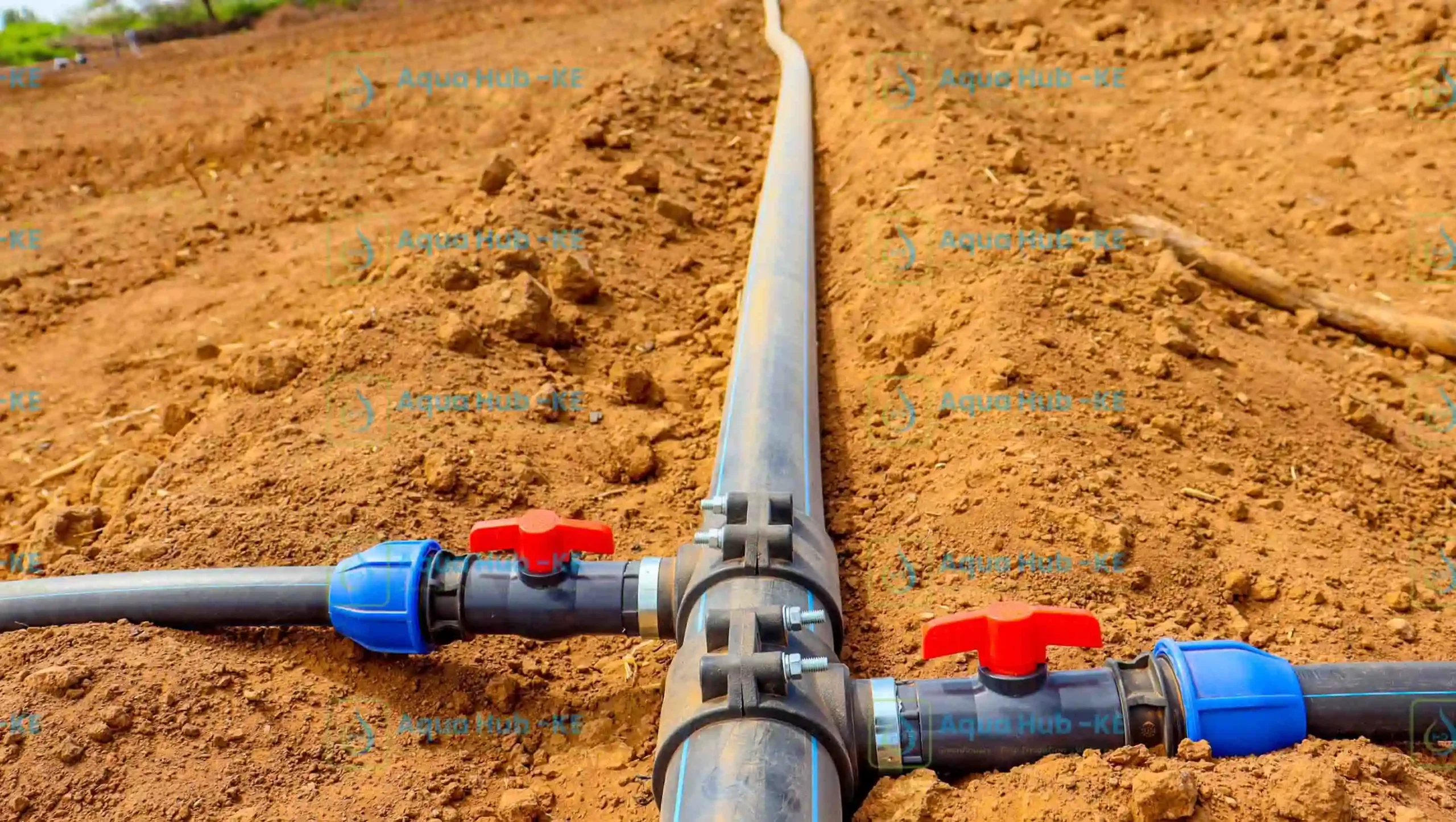
It can be difficult to choose the best irrigation pipes and fittings in Kenya, particularly when costs fluctuate greatly and each farm has unique water requirements. Many farmers face difficulties because they are unsure of which HDPE, PVC, PE tubing, dripline, or rain-hose pipe types are best for their crops. Irrigation pipes and fittings Prices range between KES 1,500 and 40,000 for HDPE pipes and KES 20 to 5,500 for PVC. To select long-lasting, reasonably priced irrigation products for your farm, this guide helps provides comprehensive price ranges.
Aqua Hub LTD has wide range of irrigation pipes and fittings including HDPE, Driplines, Rain hose pipes and connectors. Our irrigation pipes are popular for their top quality, durability and affordability.
Call 0790719020
Quick Takeaways
- HDPE, PVC, PE and driplines are the main types of irrigation pipes and fittings available in Kenya.
- Current price for HDPE irrigation pipe (100m roll) ranges from KES 1,500 to KES 40,000.
- Fittings (tees, couplings, elbows, reducers) range from as cheap as ~KES 80 to several depending on size and material.
- A typical 1-acre drip irrigation costs ~KES 65,000–130,000, depending on the number of driplines per bed and system design.
Importance of Quality Irrigation Pipes and Fittings in Kenya
A good irrigation system is designed with quality pipes and fittings to ensures consistent water supply precisely when crops need it most. Using durable pipes reduces leaks and water loss, giving you better control over irrigation schedules and enabling efficient fertigation. Reliable pipes also support different irrigation methods drip, sprinkler, or rain-hose so you can match your system to your crops, farm size, and water source.
With the right choice and quality of irrigation pipes and fittings, you spend efficiently water your crops with spending on frequent repairs.
Types of Irrigation Pipes Used in Kenya
HDPE Pipes (High-Density Polyethylene)
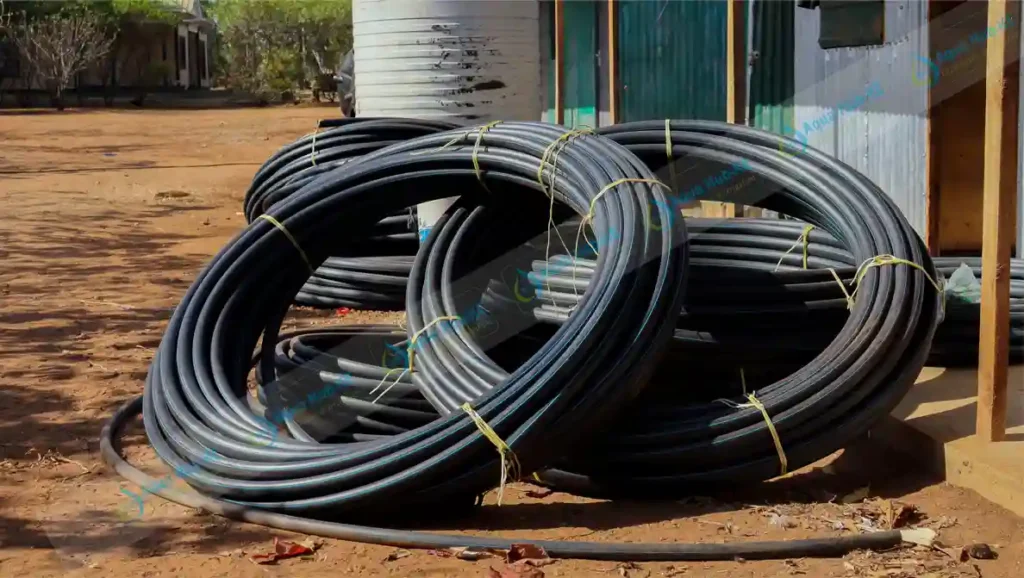
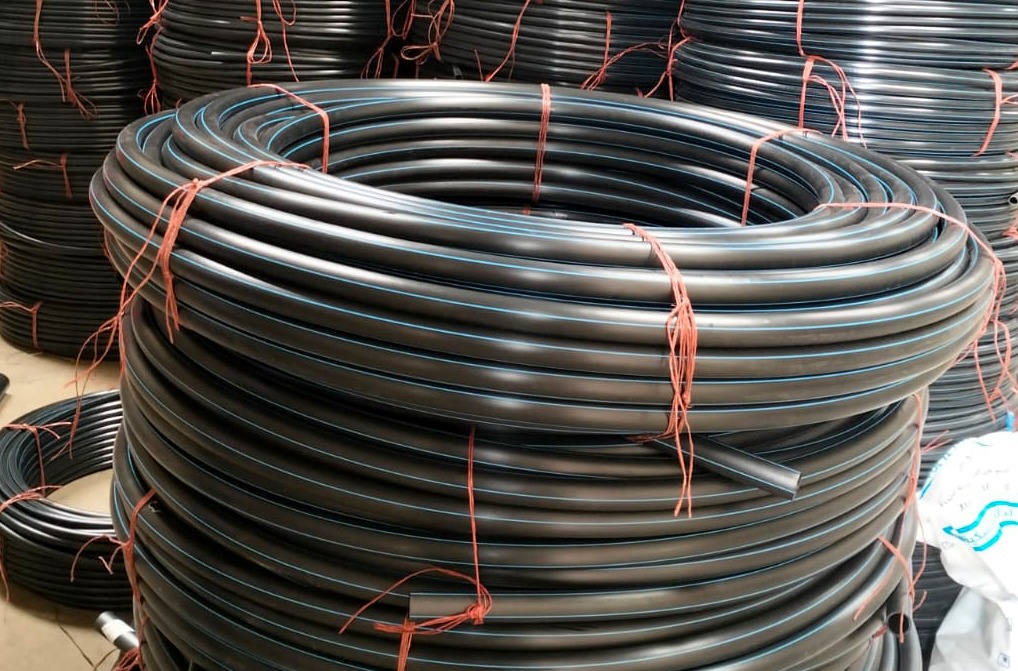
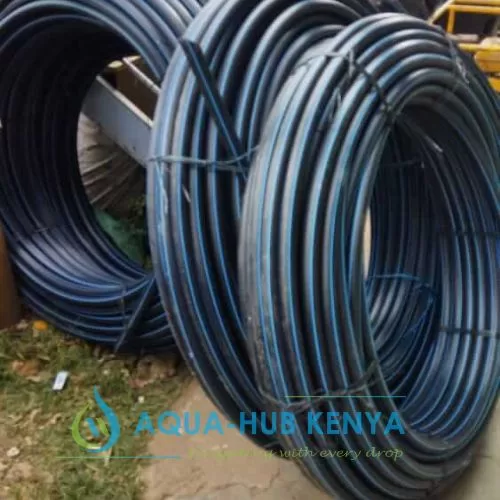
HDPE pipes are the most common type of irrigation pipes in Kenya. They are often used as the mainline and sub-mainline pipe connections. HDPE pipe is made from High Density Polyethylene material which explains their strength, durability and UV resistance.
Why HDPE is often Reliable in Irrigation
- Come in long rolls of 100m.
- Available in wide range of sizes from 20mm to 630 mm. Provide numerous options for varying project requirements.
- Pressure rating of PN6 to PN25. Handles wide range of high-pressure water flow.
- Smooth inner walls. Reduces friction and head loss.
- Connected using compression fittings. Enhances easier installation, secure and reliable water supply.
Because of these properties, HDPE is often the best option for mainline sections of a drip or sprinkler irrigation system.
PVC Pipes (Polyvinyl Chloride)
PVC pipes are alternative options for mainline or sub-mainline connection but for low pressure irrigation systems.
Common features:
- PVC is lightweight – makes it easier to move around during installation.
- Affordable – cost of PVC pipes is lower compared to other pipes
- Wide range of sizes – come in numerous diameter sizes from 20mm to 310 mm or more as well.
- Glue or solvent sealant connection – a special glue is used to connect PVC pipes.
Polyethylene (PE) | Swing Pipe
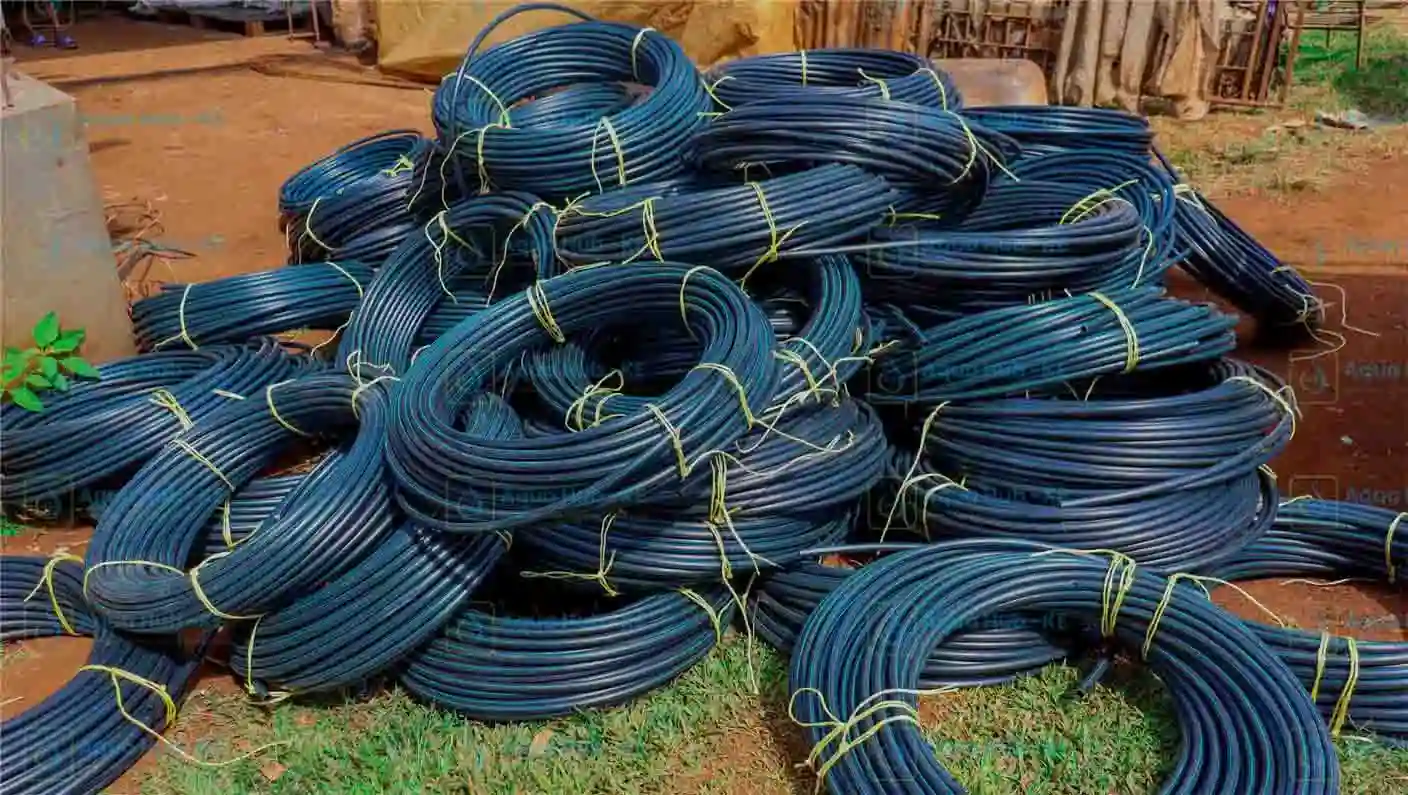
PE Pipes
Polythene pipes are flexible pipes for connecting sprinkler heads to the lateral or sub-mainline pipes. Also known as swing pipes because of their highly flexible nature.
Common features:
- Flexible nature -makes transportation, packaging and installation easier.
- Durable – last longer because they are UV treated and resistant to radiation.
- Pressure rating –
Driplines

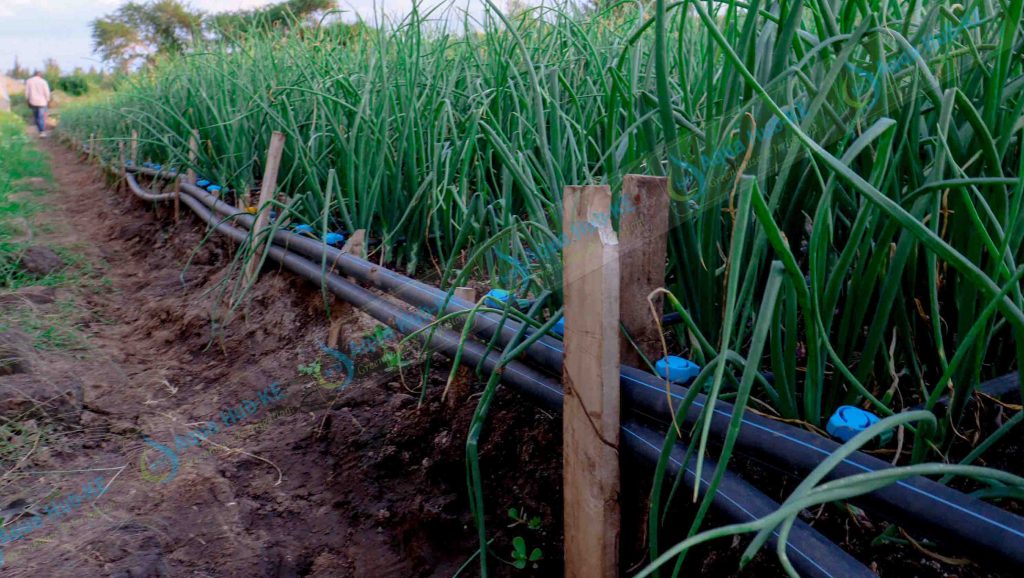
driplines installed on a bed
Special thin-walled pipes with evenly spaced emitters for drip irrigation. Driplines deliver water directly to the root zone dropwise.
Common features:
- Diameter size – 16mm
- Wide range of options as per emitter spacing – 15 cm dripline, 20 cm dripline and 30 cm dripline
- UV resistant – made from UV treated polythene material.
- Wall thickness – 0.3 or 0.4mm thus withstands pressure.
- Applicable to Specific crop types – vegetables, greenhouse crops, onions, tomato, leafy greens and capsicum.
Common Irrigation Pipe Fittings
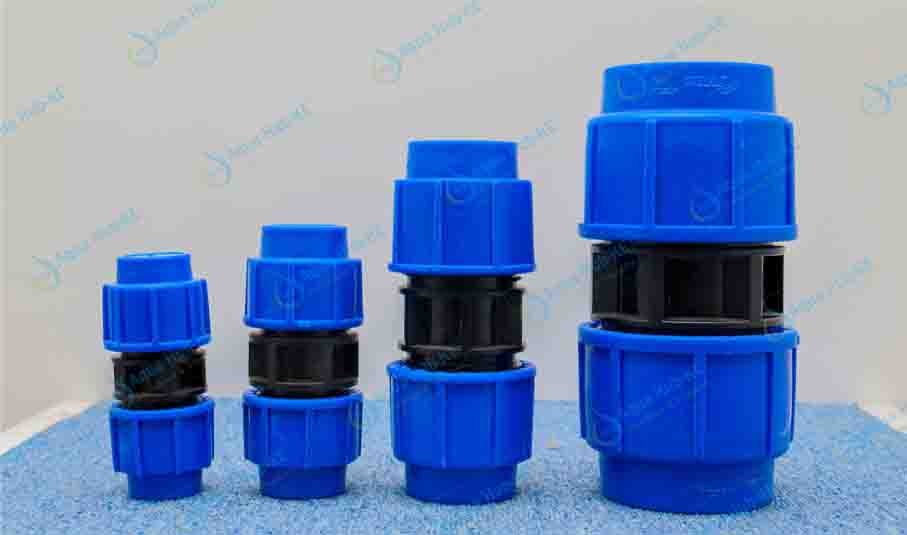
Compression Fittings
Compression fittings are used to connect HDPE pipes together along the irrigation lines. They are threaded and contain gaskets or rings for tight connection. Common types include:
- Elbows (90° / 45°) — for changing pipe direction around corners or walls.
- Tees (equal or reducing) – to branch flow into two directions (e.g. feeding two sub-mains).
- Couplings / Compression fittings — connect two pipes of the same size or extend pipe length (especially for HDPE) without glue.
- Reducers / Adapters — to connect pipes of different diameters (e.g. mainline to sub-main).
- End-caps — close pipe ends to prevent leakage when closing a branch or at the end of a run.
- Saddle clamps — alternative for Tee connector. Connect the lateral to PE pipes without cutting the main pipe.
Drip Fittings: Start Connectors, Mini-Valves, Saddle Clamps, Compression Fittings
Start connectors — join the mainline or sub-main to the dripline lateral.
Mini-valves — to control water flow or shut off certain zones, useful when fertigation or multiple crops are in use.
End plug – for closing end of driplines.
Irrigation Pipe & Fittings Prices in Kenya
HDPE Pipe Prices in Kenya
|
Diameter (mm) |
Cost (100m roll) |
|
16 mm |
1,500 |
|
20 mm |
2,700 |
|
25 mm |
3,000 |
|
32 mm |
4,100 |
|
40 mm |
5,890 |
|
50 mm |
8,000 |
|
63 mm |
12,500 |
|
75 mm |
18,000 |
|
90 mm |
26,000 |
|
110 mm |
40,000 |
Irrigation Pipe Fittings Prices in Kenya
|
Irrigation Fittings |
Size Range |
Price Range (KES) |
|
HDPE Tees, Couplings |
20–110 mm |
100 – 4,500 |
|
Elbows (90° & 45°) |
20–110 mm |
150 – 3,000 |
|
Reducer Couplings |
32–110 mm |
150 – 5,000 |
|
Saddle Clamps |
20–110 mm |
80 – 1,300 |
|
End Caps |
20–110 mm |
80 – 1,850 |
|
Adapters |
20–110 mm |
90 – 3,000 |
Dripline Prices
Dripline prices in Kenya cost KES 8, 500 per roll of 1,000m. For a complete drip irrigation system, the cost will range from KES 140,000 to 185,000 per acre. Cost varies depending on the number of driplines per bed.
How to Choose the Right Irrigation Pipes and Fittings for Your Farm
Selecting the correct pipes/fittings is important to get a system that lasts, works efficiently, and delivers the right amounts of water. Here’s what to consider:
Based on Water Source & Pressure
If your water source is a river or dam with a pump moving water to the farm – HDPE pipes with High Pressure rating, PN 10 to PN 16 are ideal.
On the other hand, water sourced from a raised tank and supplied by gravity you can use HDPE PN6, PN 8 or even PVC pipe.
Based on Irrigation Method
- For drip irrigation → use HDPE pipes, driplines and drip fittings (connectors, mini valves) for controlled water and nutrient delivery.
- For sprinkler irrigation (e.g. maize, cereals, wide spacing crops) → PE and swing pipes may be suitable.
Based on layout or Installation
- Surface installation: choose UV-resistant HDPE pipes resist sun damage.
- Sub-surface / underground: PVC or HDPE both work; less UV exposure but ensure correct wall thickness / PN rating for pressure, soil movement, and durability.
Pressure Rating (PN class), Pipe Thickness, Diameter Sizing
- PN class (e.g. PN6, PN10, PN16) must match expected water pressure (pump vs gravity).
- Mainline diameter should be large enough to supply all zones without excessive pressure drop; sub-mains/laterals sized lower.
- For drip irrigation, lateral dripline diameter is small (e.g. 16–25 mm PE) but mainlines may be 50–90 mm HDPE depending on farm size.
Common Problems and Solutions of Irrigation Pipes
- UV damage (for surface pipes): choose UV-stabilized HDPE; if using PE tubing, consider partial shading or burying.
- Leaks at joints and fittings: ensure correct installation — use proper compression fittings or good quality glue sealant. Regularly inspect and tighten or replace faulty fittings.
- Clogging (especially in fertigation): always include filters before drip lines; flush the system periodically; avoid mixing fertilizer salts at too high concentration.
- Pressure loss or uneven water distribution: check for blocked emitters, or leaks; ensure pipe diameters are adequate; for larger farms, use pressure regulators or zone valves.
Irrigation Pipes and Fittings Maintenance
- Flush lines before and after fertigation to remove residual salts and sediments.
- Inspect joints, fittings and valves every season, especially before long dry periods or heavy rains.
- Keep spare fittings and end-caps easy and quick replacements avoid long downtimes.
- For surface installations, cover exposed pipes where possible to prolong life.
Where to Buy Quality Irrigation Pipes and Fittings in Kenya
Aqua Hub Kenya. We are dealers in a wide range of irrigation pipes and fittings including HDPE, driplines and rain hose.
Our pipes range from 16mm to 110 mm diameter sizes and are sold at affordable prices.
Call 0790719020
Considerations for the Right Irrigation Pipes
Before purchasing irrigation pipes, always consider:
- PN rating / pressure class — to match your pump or water pressure.
- quality — ensure pipes and fittings are top quality.
- Compatibility – ensure connectors are suitable for your irrigation system.
- After-sale support and delivery — especially if you’re in rural areas, delivery, installation support, and availability of spare parts matter.
Tips for Smart Irrigation System Design
- Match pipe diameters to farm size & crop type. Consider the water needs of your farm to match it to the right pipe diameter and flow rate to use.
- Plan your layout with zones. Divide your farm into zones for easier irrigation and management.
- Allow for future expansion. Use larger diameter mainlines and fittings which allow you to add more laterals or driplines without needing to replace the mainline.
- Filtration and flushing points. Install filters before driplines or sprinklers to avoid clogging, especially when using river or borehole water. Add flush valves at ends.
- Design for ease of fertigation. Plan a branch line (a fertigation manifold) so that fertilizer injection affects only selected zones. This saves fertilizer, avoids clogging, and allows differential fertilization for different crops.
Frequently Asked Questions
-
What are the main types of irrigation pipes sold in Kenya?
HDPE (High-Density Polyethylene), PVC (Polyvinyl Chloride), and Drip Lines.
-
Which type of irrigation pipe is the most affordable in Kenya?
PVC pipes.
-
What is the cost of 100-meter roll of 20mm HDPE pipe in Kenya?
KES 2,700.
-
How does the size of the pipe affect the price?
The price increases as the pipe diameter increases.
-
What does “PN” refer to on irrigation pipes, and how does it affect cost?
PN stands for Pressure Nominal, which is the pipe’s pressure rating, and a higher PN rating means a higher price because the pipe is thicker.
-
Are irrigation fittings expensive compared to the pipes?
The cost of fittings like Tees and Elbows is generally a small part of the total cost, but valves can be expensive.
-
Where can one buy irrigation pipes and fittings in Kenya?
Aqua Hub LTD.
-
Do prices for irrigation supplies fluctuate in the Kenyan market?
Yes, prices can fluctuate due to the global cost of raw materials and local foreign exchange rates.
-
Is it cheaper to buy pipes and fittings in bulk?
Yes, buying in bulk purchases attracts discount.
-
What is the cost 1-acre drip irrigation kit in Kenya?
KES 140,000 to KES 180,000.